

Fixed vs. Adjustable Rate Mortgages Choosing the Right Option
No one wants to spend more than necessary on essentials like groceries, utilities, and insurance. The same thing goes for your mortgage. When it comes to financing your home, choosing between a fixed and adjustable rate mortgage can significantly impact your long-term financial health.
Considering that the average homeowner in the U.S. spends no more than 25% to 28% of their income on mortgage payments, even a small difference in interest rates can save you thousands of dollars over the life of the loan.
Read more as we compare and contrast fixed rate and ARM.
Understanding Fixed-Rate Vs. Adjustable-Rate Mortgages
When choosing a mortgage, one of the most crucial decisions you'll make is selecting between a fixed-rate mortgage (FRM) and an adjustable-rate mortgage (ARM). Both have distinct features, benefits, and potential drawbacks, and understanding these differences can help you make an informed choice that aligns with your financial situation and long-term goals.
Key Differences Between Fixed-Rate and Adjustable-Rate Mortgages

Feature | Fixed-Rate Mortgage (FRM) | Adjustable-Rate Mortgage (ARM) |
|---|---|---|
Nature of Interest Rates | Constant interest rate throughout loan | Initial lower rate, adjusts periodically |
Initial Interest Rate | Higher than ARM | Lower than FRM |
Monthly Payments | Stable, predictable | Initial low payments, can vary over time |
Interest Rate Stability | Unchanged for loan term | Adjusts based on market conditions |
Rate Caps | Not applicable | Periodic, lifetime, initial adjustment caps |
Down Payment Requirements | Typically lower (around 3%) | Typically higher (around 5%) |
Best For | Long-term stability, predictable budget | Short-term savings, flexibility |
Nature of Interest Rates
Fixed-Rate Mortgage (FRM): With an FRM, your interest rate remains constant throughout the life of the loan. This means your monthly payment of principal and interest stays the same, providing predictability and stability.
Adjustable-Rate Mortgage (ARM): An ARM starts with a lower initial interest rate and monthly payment compared to an FRM. However, after the introductory period (typically 5, 7, or 10 years), the interest rate adjusts periodically based on a specified index plus a margin. This means your monthly payments can increase or decrease over time.
Detailed Comparison
Initial Interest Rate and Payments
FRM: The interest rate is typically higher at the beginning compared to an ARM. This results in higher initial monthly payments but ensures that these payments remain the same for the duration of the loan.
ARM: The initial interest rate is usually lower than that of an FRM, leading to lower initial monthly payments. This can be advantageous if you plan to move or refinance before the rate adjusts.
Interest Rate Over Time
FRM: The interest rate and monthly payment remain unchanged for the entire loan term. This stability makes it easier to budget and plan for the future, as there are no surprises in your mortgage payments.
ARM: After the initial fixed-rate period ends, the interest rate adjusts periodically. These adjustments are based on market conditions and can result in higher or lower payments. If interest rates rise significantly, your monthly payments could become unaffordable. However, if rates fall, you could benefit from lower payments.
Rate Caps
ARM: ARMs come with rate caps that limit how much the interest rate can increase at each adjustment and over the life of the loan. Common caps include:
Periodic Adjustment Cap: Limits how much the interest rate can change at each adjustment period.
Lifetime Cap: Limits the total increase in the interest rate over the life of the loan.
Initial Adjustment Cap: Limits the amount the interest rate can increase the first time it adjusts after the fixed period ends.
These caps provide some protection against drastic rate increases, but they do not eliminate the risk entirely.
Down Payment Requirements
FRM: Conventional fixed-rate loans often have lower down payment requirements, sometimes as low as 3%.
ARM: Conventional ARMs usually require a higher down payment, typically around 5%. This higher initial cost can be a barrier for some borrowers.
Choosing the Right Option
Stability and Long-Term Planning: If you value stability and predictability in your monthly payments and plan to stay in your home for a long period, a fixed-rate mortgage might be the best choice. The certainty of knowing your payments won't change can make it easier to manage your finances.
Short-Term Savings and Flexibility: If you expect to move, sell, or refinance within a few years, or if you believe interest rates will remain stable or decrease, an adjustable-rate mortgage might be more suitable. The lower initial rate and payments can save you money in the short term.
Example Scenario
To illustrate the impact of these differences, consider a $400,000 loan:
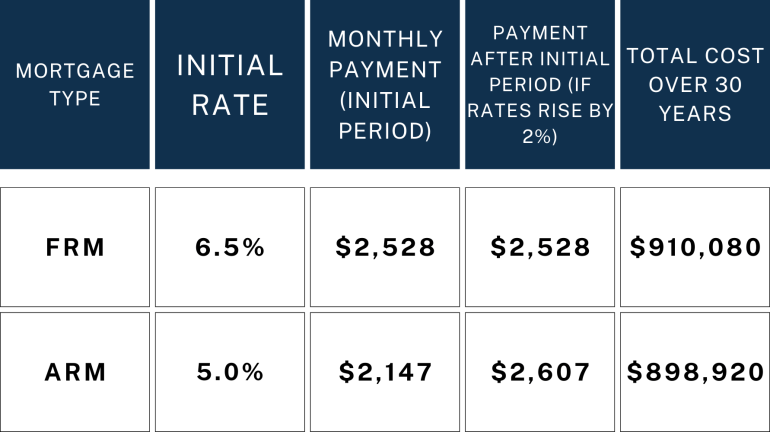
Mortgage Type | Initial Rate | Monthly Payment (Initial Period) | Payment After Initial Period (if rates rise by 2%) | Total Cost Over 30 Years |
|---|---|---|---|---|
FRM | 6.5% | $2,528 | $2,528 | $910,080 |
ARM | 5.0% | $2,147 | $2,607 | $898,920 |
How Does Fixed Mortgage Rate Work?
A fixed-rate mortgage is like the trusty old friend who’s always there for you, never changing, no matter what. With a fixed-rate mortgage, your interest rate is set when you take out the loan and it stays the same for the entire term of the loan. This means that your monthly payments for principal and interest will remain constant throughout the life of the loan—whether it's 15, 20, or 30 years.
FRM offers a lot of stability and predictability. You know exactly what you're going to pay every month, which makes budgeting a lot easier. There's no worrying about fluctuating interest rates or unexpected increases in your payments.
Here’s a quick example: If you have a $300,000 fixed-rate mortgage at 4% interest for 30 years, your monthly payment for principal and interest would be around $1,432. This amount won’t change for the upcoming years.
How Does Adjustable Rate Mortgage (ARM) Work?
If a fixed-rate mortgage is like your steady, predictable friend, an ARM is more like your adventurous buddy who’s always up for something new and different.
An ARM starts off with a lower interest rate compared to a fixed-rate mortgage. This initial rate is usually fixed for a certain period—commonly 5, 7, or 10 years.
For example, with a 5/1 ARM, the “5” means the rate is fixed for the first five years, and the “1” means the rate adjusts every year after that.
Once the initial period is over, the interest rate can change periodically, based on the market conditions. The new rate is determined by adding a margin to a specific index (like the LIBOR or the Treasury Index). This means your monthly payments can go up or down, depending on how interest rates are moving.
Here’s why some people go for ARMs: The initial lower rate means you’ll have lower monthly payments at the start. This can be a great option if you’re planning to move or refinance before the initial fixed-rate period ends. However, there’s a bit of a gamble involved—if interest rates go up after the initial period, your payments could increase significantly.
For example, let’s say you have a $300,000 5/1 ARM with an initial rate of 3%. For the first five years, your monthly payment would be around $1,265. After that, if the rates go up, your payments could increase, but if they go down, your payments might decrease too.
Which One is Right for You?
Deciding between a fixed-rate mortgage and an ARM depends on your personal situation and financial goals.
Choose a fixed-rate mortgage if you value stability and plan to stay in your home for a long time. It’s perfect for those who like to know exactly what they’ll be paying each month without any surprises.
Consider an ARM if you plan to move, sell, or refinance within a few years, or if you’re confident that interest rates will stay the same or decrease. The lower initial payments can provide significant short-term savings.
Payment Example Of Fixed Mortgage Rate & Adjustable Rate Mortgage (ARM)
Understanding how your mortgage payments could change over time is crucial when deciding between an ARM and a fixed-rate mortgage. While the initial payments of an ARM may seem more appealing, it's important to consider the potential maximum payments you could face. Here’s a unique example to help you visualize the differences, assuming a first adjustment cap of 2 percent, subsequent adjustment caps of 1 percent, and a lifetime cap of 5 percent:

Header | 5/1 ARM (30 years) | 30-Year Fixed-Rate Mortgage |
|---|---|---|
Home Price | $450,000 | $450,000 |
Loan Amount | $427,500 (5% down) | $436,500 (3% down) |
Initial Interest Rate | 5.5% | 6.5% |
Initial Mortgage Payment | $2,427 | $2,764 |
Maximum Interest Rate | 10.5% | 6.5% |
Maximum Mortgage Payment | $3,739 | $2,764 |
Breakdown:
Initial Payments:
5/1 ARM: With an initial rate of 5.5%, your monthly payment would be $2,427. This lower initial payment can be quite attractive.
Fixed-Rate Mortgage: At a 6.5% interest rate, your monthly payment would be $2,764. While higher than the ARM's initial payment, this amount will not change over the life of the loan.
Potential Maximum Payments:
5/1 ARM: After the first five years, if interest rates rise, your rate could increase by up to 2% at the first adjustment, reaching 7.5%. Subsequent annual adjustments could add up to 1% per year, eventually capping at 10.5%. If it hits this cap, your monthly payment could rise to $3,739.
Fixed-Rate Mortgage: The payment remains $2,764 throughout the 30-year term, providing consistent and predictable payments.
Important Considerations
Adjustment Caps: In this example, the ARM has a first adjustment cap of 2%, which means the highest your interest rate could go in the first adjustment period is 7.5%. Each subsequent year, the rate could adjust by up to 1%, but will never exceed the lifetime cap of 10.5%.
Market Dependence: The ARM’s interest rate adjustments are tied to market conditions. If interest rates decrease, you could benefit from lower payments. Conversely, if rates rise, your payments will increase. The fixed-rate mortgage offers stability, insulating you from market fluctuations.
Loan Amount and Down Payment: Notice the slight difference in loan amounts due to different down payment requirements (5% for ARM and 3% for fixed-rate). This affects the initial monthly payments as well.
Using Calculators
Using tools like Bankrate’s mortgage calculator can help you understand and compare the long-term costs of fixed-rate loans versus ARMs. By inputting your specific loan details, you can see how different interest rates and adjustments will impact your payments over time.
What Are They Best For?
Mortgage Type | Best For |
|---|---|
Fixed-Rate | Stability, long-term residence, predictable budgeting, risk-averse individuals, families on fixed incomes |
Adjustable-Rate | Short-term residence, lower initial payments, savvy financial planners, those open to market fluctuations |

Fixed Mortgage Rate Is Best For
A fixed-rate mortgage is perfect for those who value stability and long-term planning. If you're the type of person who likes to know exactly what your future holds, especially when it comes to your finances, this mortgage option is ideal. Your interest rate and monthly payments for principal and interest will remain the same throughout the life of the loan.
This predictability makes budgeting much easier knowing that no matter what happens in the broader economy, your mortgage payment won't change. It’s a great choice if you plan to stay in your home for many years, giving you a sense of financial security.
Additionally, a fixed-rate mortgage is an excellent fit for those who are risk-averse and prefer not to deal with the fluctuations of the market. With a fixed-rate mortgage, you avoid the uncertainty that comes with potential interest rate increases.
This makes it easier to plan for the long term where you can truly ensure that your housing costs remain steady. It’s particularly beneficial for families or individuals on a fixed income who need to maintain a consistent budget without worrying about potential increases in their monthly expenses.
Adjustable Rate Mortgage (ARM) Is Best For
An adjustable-rate mortgage (ARM) can be a great option for those who are comfortable with a bit of risk and are looking to take advantage of lower initial interest rates. If you know that you'll only be in your home for a short period—say, five to seven years—an ARM can save you a significant amount of money in the early years.
This is because ARMs typically start with a lower interest rate compared to fixed-rate mortgages, resulting in lower monthly payments initially. This can be particularly appealing for first-time homebuyers or those planning to relocate or upgrade to a different home before the adjustable period kicks in.
Moreover, ARMs are suitable for well-informed financial planners who keep a close eye on interest rate trends and are open to refinancing. If you believe that interest rates will remain stable or even decrease, an ARM can be a smart choice.
You enjoy lower payments at the beginning, and if market conditions are favorable, you might refinance into a fixed-rate mortgage before the adjustment period, thus locking in a lower rate long-term. It’s a bit of a gamble, but for the right person, it can be a financially strategic move that maximizes savings and offers flexibility.


Frequently Asked Questions
Many homeowners prefer a fixed-rate mortgage because it offers stability and predictability. With a fixed-rate mortgage, your interest rate and monthly payments remain the same throughout the life of the loan. This consistency makes it easier to budget and plan for the future, as you won't have to worry about interest rate fluctuations impacting your monthly payment. It's particularly appealing to those who plan to stay in their home for a long time and want the peace of mind that comes with knowing their payment amount won't change.
An adjustable-rate mortgage (ARM) can be a good choice if you expect to move or refinance before the initial fixed-rate period ends, typically 5, 7, or 10 years. ARMs often start with lower interest rates compared to fixed-rate mortgages, which can mean lower initial monthly payments and significant savings. If you’re confident that your income will grow or that you won’t be in the home for the long term, an ARM can be a cost-effective option.
Choosing the right mortgage is crucial because it impacts your financial stability and long-term goals. The right mortgage can save you thousands of dollars in interest and fees, help you build equity faster, and fit seamlessly into your budget. Conversely, an inappropriate mortgage choice can lead to higher payments, financial stress, and even the risk of foreclosure if you're unable to meet your obligations. It's about finding a mortgage that aligns with your financial situation and future plans.
The primary reason a borrower might choose a fixed-rate mortgage is for the predictability and stability it offers. With a fixed-rate mortgage, you lock in an interest rate that won't change for the life of the loan. This means your monthly payments remain constant, making it easier to budget and plan for the future. It’s especially appealing in a low-interest-rate environment, as you can secure a good rate for the long term and protect yourself from potential rate increases.